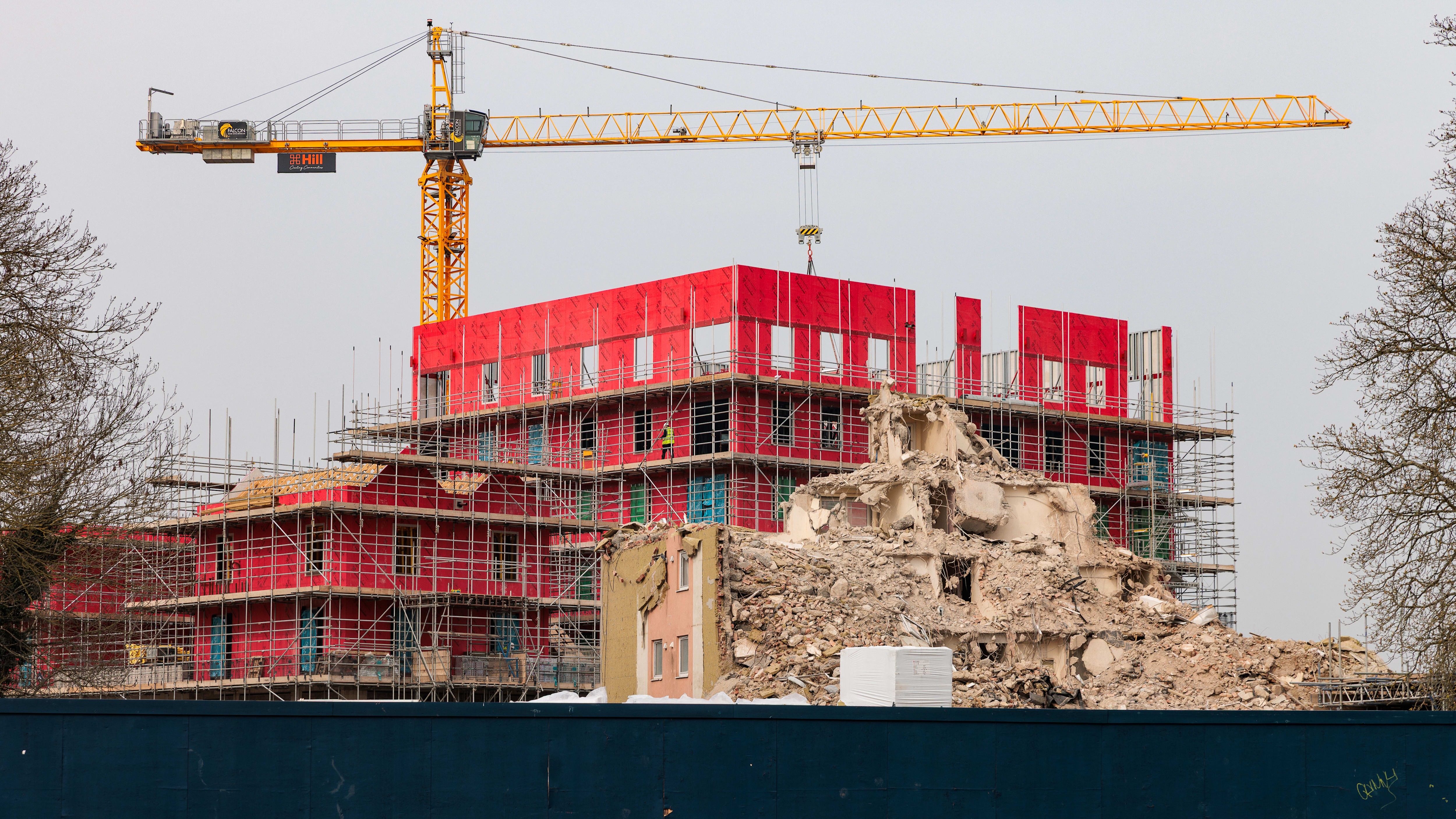
Property experts have questioned whether Prime Minister Andy Burnham’s key mission to build the most council homes since the postwar period will survive contact with reality, given the UK housebuilding industry is in turmoil.
Burnham has put the country’s housing crisis at the centre of his domestic agenda. However, property experts highlight that while Labour pitched an overly ambitious target of building 1.5mn new homes when it came to power two years ago, there have been fewer homes built since then than under the Conservatives.
The housing sector, which has grown accustomed to a revolving door of 14 ministers in the last decade, is still hopeful that it will benefit from greater political attention with the appointment of John Healey as chancellor.

Attention is needed: UK-listed housebuilders have issued eight profit warnings during the first half of 2026, including six in the second quarter of this year, the highest first-half total since the start of the pandemic, according to EY Parthenon’s Profit Warnings watch. The sector is facing the twin challenges of a slump in demand and rising costs.
The early days of the new era have led to nervousness about whether a government led by Burnham — who has been explicit about the need for more public ownership of nationally important companies — could adopt a more radical approach, including some form of control.
This is particularly pertinent when it comes to Vistry, the lossmaking housebuilder.
Nick Williams, a former infrastructure adviser to Sir Keir Starmer, recently wrote a private memo arguing that Vistry should be nationalised and turned into a new “delivery body” for the government’s plans.
Although Williams left Downing Street over a year ago, he has been recently advising Louise Haigh, the incoming first secretary and Cabinet Office minister.
In his paper from earlier this year, Williams argued that ministers could use legislation to nationalise Vistry in the way that the government recently took control of British Steel.
“It is a ready-made delivery body for strategic projects like New Towns. Acquiring it would be faster and simpler than building a public corporation from scratch and it is currently cheap,” he wrote in the paper, seen by the FT. “An acquisition would be a politically significant proof point for the strategic power of the state.”
Williams declined to comment.
Nationalisation is not an option the government is currently considering, according to a person familiar with the situation.
A Vistry spokesperson said: “There have been no discussions between Vistry and the government on this matter. We have made it clear that we are prioritising cash generation and are taking decisive steps to reduce debt levels, and we have made significant progress over the past few months. While current market conditions are challenging for all companies in our sector, we continue to build at scale and pace, delivering the homes this country so desperately needs, including just under 6,500 in the first half alone.”
Nevertheless, the government has been monitoring Vistry, whose value has fallen by about £1.2bn so far this year. The company’s involvement in public sector schemes, and its access to expanded long-term grant funding at scale, means the government would have to find new partners were the company to fail.

Last week Will Garton, delegated permanent secretary at the Ministry for Housing, Communities and Local Government, was asked by MPs if the government had done any “contingency planning” in case the company enters “distressed” status.
Garton declined to be drawn on Vistry and said: “We monitor the performance of the big housebuilders, keep a close eye on the market and are aware of all developments.” He added that the government was “in touch”.
There has been “no day-to-day monitoring”, according to a person familiar with Vistry’s position.
There is also the question about how the government could fund a takeover of Vistry, which has an enterprise value of £1.1bn, other than another repurposing of the National Wealth Fund, said one property boss. The government is already eyeing control of Thames Water, which is struggling under a near-£20bn debt pile.

Vistry is currently the UK’s most heavily shorted stock despite its shares already falling by 56 per cent in the year to date. The housebuilder, which was created through the combination of Bovis Homes and Galliford Try six years ago, has accelerated cost-cutting measures including voluntary redundancy programmes. However, a restructuring expert said that “Vistry was not distressed enough to be considered a failing firm yet. This is not a Thames Water situation.”
Even Vistry’s rivals raise concerns that any attempt to increase public control would make investors balk in a sector that relies on overseas buyers. “It would have to be consensual to avoid risking major capital flight,” said one chief executive at another housebuilder.
The struggles in housebuilding have been blamed on a slump in demand due to buyers’ affordability challenges, combined with rising inflationary pressures. Policy costs and extra regulation also mean that companies are not risking building homes that will not sell.

Many developments have targets of between 20 and 50 per cent set aside for local authority affordable homes.
However, if none of these developments are being built, “40 per cent of nothing is still nothing”, one property leader said. And so the challenge of a lack of affordable housing worsens.
On top of the demand challenges, housebuilders have also been grappling with a slew of extra costs including inflation from raw materials, the Building Safety Act levy, a landfill tax and other green rules.

Analysis by the Home Building Federation estimates that developers are facing an extra £76,000 in new costs per home since 2020, equivalent to a fifth of the average new home value of £365,000. Housebuilders in the south-east have said that margins have been almost wiped out and that red tape has worsened: the Building Safety Act, brought in after the Grenfell Tower disaster, applies to high-rise buildings, which are more common in London and other cities.
Sarah Rayment, co-lead of global restructuring at Kroll, said: “Compliance is leading to large delays and huge costs. Currently, backlogs are adding months to projects, which in turn places huge financial costs and distress on some developers.”
Burnham has said that he intends to kick-start house building by seizing more public-sector brownfield space.
Publicly owned brownfield land in England has capacity for, at most, 187,000 to 207,000 homes, according to fresh analysis by lender Together, using data from property platform Searchland. That compares to a 300,000 social and affordable home programme that Labour has previously announced.

“There isn’t enough public land to deliver a programme this size, and that’s before considering that the places with the greatest need tend to have the least land. As it stands, whether this pledge reaches your community is close to a postcode lottery,” said Ryan Etchells, chief commercial officer at Together.
Others in the sector say that efforts to push disused military airfields and former hospital grounds have also run into issues with the Ministry of Defence and Health Department.
Recommended
Burnham has said that the UK is in a “housing trap” while research shows that there are 1.3mn households currently on council housing waiting lists and 176,000 children living in temporary accommodation. However, his ambition to fix this will also need greater collaboration with local authority housing associations, which experts claim are understaffed and do not have the resources while they await grant funding to be released.
Property experts say that regulations need to be eased, planning rules accelerated and more funding alongside a potential repurposing of Homes England. According to one CEO in the sector: “Burnham has said he will set out a 10-year vision; it will take that at least to sort the housing crisis.”
Data visualisation by Clara Murray in London