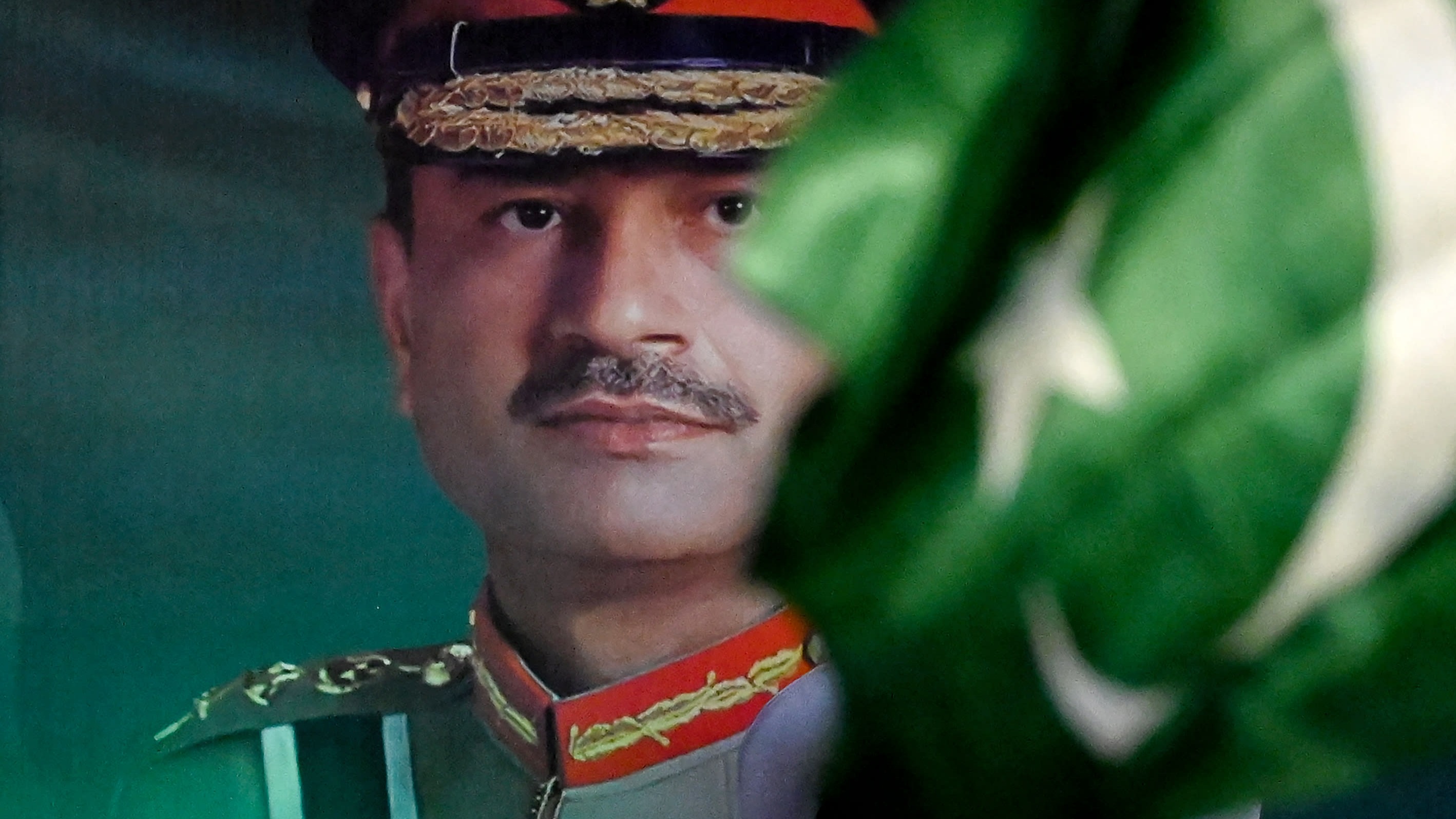
The day before Field Marshal Asim Munir was due to host a peace summit between the US and Iran in April, Saudi Arabia made a special request.
The kingdom’s finance minister Mohammed al-Jadaan turned up at Islamabad’s gilded Prime Minister House on the evening of April 10 and asked Munir to show support for Riyadh as they discussed a loan, according to two people briefed on the conversation.
Saudi Arabia was being assailed by Iranian missiles and drones. Riyadh, which agreed a defence pact with Islamabad last year, wanted Munir, Pakistan’s de facto leader, to send men and munitions.
Islamabad worried such a move risked undermining the impending talks and stirring a backlash in Pakistan, where millions sympathise with Tehran. But the country desperately needed Riyadh’s patronage. Days before, the United Arab Emirates had shocked Islamabad by calling in $3.5bn in loans — a sum equal to a fifth of Pakistan’s central bank reserves.
Munir dispatched a squadron of fighter jets and airmen, as well as a Chinese-made HQ-9 air-defence system, to a Saudi air base facing Iran’s shores, the people say. The following week, Riyadh lent its ally $3bn.
The episode illustrates Munir’s growing global clout as he capitalises on Islamabad’s ties with Riyadh, Washington and Beijing and uses his authority to remake the country’s foreign policy. It also highlights the economic and political challenges the army strongman hopes to keep a lid on through his authoritarian style of rule.
At the same time, Munir hopes to counter Pakistan’s richer and stronger arch nemesis, India, by strengthening regional alliances.

“As a south Asian power, Pakistan is permanently number two to India, the wealthier, stronger and more useful nation to the US in that region,” says Feroz Khan, a retired Pakistani brigadier who served on the country’s strategic plans division, which oversees its nuclear arsenal. “But in the Middle East, it believes it can come into its own, with the blessing of US Central Command and Saudi Arabia.”
Indeed, in response to the Iran war, Pakistan has deepened its co-ordination with Saudi Arabia, Egypt and Turkey — a quartet that together hopes to help stabilise the region and shape a postwar security order. The grouping could prove a counterweight to the growing military co-operation between the UAE, Israel and India, analysts say.
But back home, Pakistan’s problems are mounting in both economic and security terms, raising the question of whether Munir’s ambitions are merely a distraction from the country’s crises and whether he may ultimately be undone by them.
The country of 255mn is mired in debt and restrained by the IMF, which has bailed it out 25 times. Last year, the official poverty rate shot up to a decade-high of 29 per cent. Meanwhile, Pakistan’s forces are fighting Baloch separatists and the Pakistani Taliban, who are both gaining strength in the west, hampering plans to turn the country’s poorest regions into resource-extraction hubs.
“Given its deep economic and political weaknesses, [Pakistan’s] nuclear bomb, its conventional military forces and diplomacy are all it has to punch above its weight as a middle power,” says Khan who now teaches at Naval Postgraduate School in California.
There are limits to diplomacy. The day after he received the Saudi finance minister, Munir chaired 21 hours of talks between US vice-president JD Vance and Iranian leaders that laid the foundations for last month’s “Islamabad Memorandum of Understanding”, a 14-point ceasefire agreement.

But the diplomatic coup did not last long. In response to Iranian attacks on shipping, US President Donald Trump declared the ceasefire “over” this month and renewed strikes on the country. Tehran has hit back with missiles and drones against Gulf states and again shut the Strait of Hormuz, through which almost all of Pakistan’s fossil-fuel imports pass.
Given Pakistan’s multiplying domestic issues, critics question the urgency of Munir’s foreign policy agenda. “What good is a bigger voice on the world stage if the house is on fire?” says Maleeha Lodhi, a former Pakistani ambassador to the US and UK. “Pakistan needs to fix the cracks within.”
‘Now it’s only a crackdown’
Munir aspires to turn Pakistan into what he calls a “hard state” and rules Pakistan with a “massive chip on his shoulder”, says one former US diplomat who has dealt with him extensively. He has empowered Pakistan’s security forces, hoping to stamp out militancy, end decades of political instability and attract foreign investment.
The field marshal, who was born in 1968, is the son of an imam and the country’s first military chief to claim to have memorised the entire Koran. His professed piety, coupled with his training at a lesser-known officer school rather than the Anglophile academies of his predecessors, sets him apart from the military’s more urbane officer class.
When Prime Minister Shehbaz Sharif appointed him army chief, Pakistan’s most powerful office, in November 2022, the nation was haemorrhaging cash reserves and reeling from the ousting of former prime minister Imran Khan, a charismatic former cricket captain. Munir and his allies blame Pakistan’s decade-long experiment in civilian-led democracy for those crises. He has spent the last three and a half years entrenching the military in domestic affairs.

After candidates loyal to Khan — who had fired Munir from Pakistan’s top spymaster post in 2019 — won the most seats in elections in 2024, Sharif’s government relied on the military to cling to power.
In return, the rubber-stamp parliament has ceded unprecedented decision-making powers to Munir, including setting him up for potentially a decade of rule by extending his term of office as military chief and handing him control of the air force and navy. New laws and backroom intimidation have also curbed judicial independence and muzzled public criticism of the military.
But such moves have done little to placate Pakistan’s restive western regions. Pakistan is struggling to secure the 1,300km of highways connecting its main port of Karachi to the copper-rich deserts near the borders with Iran and Afghanistan from militants and brigands.
Recent raids and suicide bombings have prompted Canada-based Barrick Mining to postpone development of its $9bn Reko Diq copper and gold mine, while a nearby China-backed copper mine also threatened to suspend its operations last month.

Last year was also the deadliest year for Pakistan’s security forces in more than two decades, according to the South Asia Terrorism Portal, a New Delhi-based database. Since January, over 1,270 civilians and security personnel have died, 26 per cent more than for the same period in 2025.
Lt Gen Ahmed Sharif Chaudhry, the spokesperson for the Pakistan military, says the country is taking a “tiered approach” to solving its militancy issue, including overhauling local police forces, increasing provincial spending on security and development and launching military operations to flush out hide-outs.
“This is going to take time,” he acknowledges in an interview at the army’s General Headquarters in Rawalpindi. “But there is local money for local people, local projects and local consumption” to break what he calls the “terror-crime nexus”.
Islamabad blames much of the violence on meddling by India, which denies all responsibility, as well as safe havens and weapons provided by Afghanistan’s Taliban leaders, with whom it is openly at war.
Critics, however, point the finger at increasing repression within Pakistan. By blocking access to an independent judiciary, free press and civil protest, “the regime is in effect incentivising aggrieved elements to take up arms against the state,” says Adeel Malik, an associate professor of development economics at the University of Oxford.
Nadia Baloch, a 26-year-old lawyer in the south-western city of Quetta, says the effective ban on public dissent has prompted people she knows to look for “a different, third route”.

Last month Baloch’s sister Mahrang was sentenced in an anti-terrorism court to life in prison for allegedly inciting a mob to kill a soldier in 2024.
For years Mahrang had led demonstrations across the south-western Balochistan province, demanding accountability for thousands of alleged state-sponsored disappearances and killings.
Mahrang and her supporters fiercely deny the charges and say their movement is strictly non-violent. The military has said she is a “proxy for terrorists”.
“This is the hard state policy,” says Baloch, of her sister’s sentence. “There have always been human rights violations, but we had space for protests and sit-ins and press conferences. Now, it’s only a crackdown.”
Keep your friends close
Since Pakistan gained independence in 1947, menace at the country’s borders and in its vicinity has forced it into a complex web of alliances and dependencies to survive and assert its power.
During the cold war, its most cherished allies were the fiercely anti-communist US and neighbouring Maoist China. In July 1971, amid a bloody civil war with Bengali separatists in East Pakistan, military dictator Yahya Khan leveraged those ties to engineer US secretary of state Henry Kissinger’s secret visit to Beijing.
But Pakistan still lost the war — and Bangladesh gained independence — after Indian forces invaded. The resulting national trauma led Prime Minister Zulfikar Ali Bhutto to hunt for allies in the oil-rich Middle East, where he pitched Islamabad as the “eastern fortress of the Muslim World”, according to Khan, the retired brigadier.
Saudi Arabia’s King Faisal and Libya’s Muammer Gaddafi provided financing for the country’s early nuclear weapons programme. The two autocrats later became the namesakes of a major Pakistani city and its national cricket stadium respectively.
China has also supported Pakistan’s nuclear and ballistic missile programmes, as well as putting in train over $30bn of power and infrastructure projects across the country, including the deep-water port of Gwadar on the Arabian Sea.
“There are two countries with whom Pakistan has a special relationship: China and Saudi Arabia,” says Chaudhry, the military spokesman. “With them, there is never a quid pro quo.”
Beijing remains Islamabad’s main arms supplier; it and Riyadh are the country’s biggest bilateral creditors.
Chaudhry denies any connection between the April deployment to Saudi Arabia and the $3bn loan from Riyadh: “This is a special, decades-old relationship based on a very strong religious foundation and mutual respect.”
Then there is the third big country with which Munir’s Pakistan has cultivated ties — the US. In June last year Islamabad nominated Trump for the Nobel Peace Prize for his “decisive diplomatic intervention” towards ending Pakistan’s four-day conflict with India the month before. In October, the US president, who once said Pakistan had given the US “nothing but lies and deceit”, referred to Munir as his “favourite field marshal”.
Now Munir enjoys the warmest relationship any Pakistani leader has shared with the White House in years.
“Munir took a significant risk by staking his standing on diplomacy that could easily have backfired,” says Asfandyar Mir, a senior fellow for South Asia at the Stimson Center in Washington, referring to the field marshal’s role securing the MoU with Iran. “But Trump, in a departure from the India-centric consensus that has defined American policy for a decade, allowed Pakistan to make its play.”
Still, Munir’s attempt to recast Pakistan’s role in the world goes far beyond his courting of powerful potential patrons.
Last week, he met Turkey’s president Recep Tayyip Erdoğan and its military leaders in Ankara. His efforts to deepen ties with the country and with Saudi Arabia come as some Gulf petrostates are questioning their dependency on US security commitments, equipment and bases.
The emerging alliance could marry Riyadh’s deep pockets with Ankara and Islamabad’s battle-hardened armies and robust defence production capabilities. Turkey and Pakistan are already co-operating on drone development.
“Pakistan has a clear interest in peace in the larger Muslim world, and particularly the Gulf,” says Chaudhry, the military spokesman. “The countries of the Gulf know this and are therefore more comfortable dealing with us as a security partner and honest broker.”
During the war, Islamabad has sought to use its ties to both Tehran and Riyadh to urge the two regional heavyweights not to escalate against each other.
“Pakistan has been working with all of the stakeholders in the Gulf as well as Iran to ensure that this war should not spiral and should not expand,” Chaudhry says.
The mutual defence agreement signed with Saudi Arabia in September, still undisclosed and approved without parliamentary input, “states that any aggression against either country shall be considered an aggression against both”, according to official statements from Riyadh and Islamabad.
Islamabad and Riyadh are also exploring a joint aerial defence system, according to a person briefed on the matter, to plug holes exposed by the Iran war and 2019 Houthi drone attacks that briefly shut down some Saudi oil facilities.

An expanded military footprint in the region also helps Pakistan protect its 5.5mn citizens working in the Gulf, whose over $20bn in annual remittances underpin the country’s reserves.
In Saudi Arabia, says Umer Karim at the Riyadh-based King Faisal Centre for Research and Islamic Studies, “you have a state which will always at least try to provide you with a degree of financial cushion in moments of great need”.
At present, Pakistan owes some $8bn to the Gulf kingdom, equivalent to 46 per cent of its own central bank reserves, and depends on Riyadh to push back its repayment deadlines so it can avoid bankruptcy.
It is an extreme reliance on a creditor threatened by Iran, which enjoys widespread sympathy in Pakistan, particularly among the country’s 40mn-strong Shia minority. When Ayatollah Ali Khamenei was assassinated by Israel in February, riots broke out across Pakistan that left at least two dozen people dead.
There is also a risk that Islamabad’s patrons can take their money back. In April, the UAE lashed out at Pakistan, once a close defence partner, for its pro-Saudi tilt and its mediation role with Tehran by demanding the immediate repayment of the $3.5bn loan.
With Houthi rebels firing missiles and drones at Saudi Arabia and its tankers in recent days, Pakistan faces a new risk of being sucked into conflict. “Considering Pakistan’s indispensable financial dependence on Saudi Arabia, it essentially won’t have much of a choice,” Karim says.
Straitened times
Pakistan’s power abroad depends on economic strength that the country does not yet have. It lags behind regional peers, including India, in per capita terms. According to the World Bank, the country spends far less on health and education as a percentage of GDP than other lower-middle-income countries, leaving 25mn children out of school, 78 per cent of them mostly illiterate by age 10, and 40 per cent overall stunted.
The IMF in May praised the government’s “strong implementation” of its $7bn bailout programme. But according to rating agency Fitch, interest payments on debt will eat roughly 40 per cent of Pakistan’s revenues in the year to June 2027.
This week the country asked Washington for $10bn in financial support to boost its foreign exchange reserves.
It has not fixed the root causes of repeated balance of payments crises. Although growth is projected to reach 3.7 per cent for the year to June 2026, according to official statistics, the trade deficit also reached a four-year high of $39.6bn amid declining export earnings, higher imports and surging commodity prices linked to the war in the Gulf.

“There’s a small group of decision makers . . . that realise if they don’t fix this economy, they will fall off the cliff of a deep economic and even political crisis,” says Stefan Dercon, a professor at Oxford who is advising Sharif on economic reform.
Yet even as the government demands austerity, the military takes priority. Parliament last month approved a budget that raised defence spending by 18 per cent.
“We are in a period of forced spending cuts,” says Ali Hasanain, an associate professor of economics at the Lahore University of Management Sciences. “We haven’t widened the tax net, while financing real increases in defence spending year on year.”
A military-led investment vehicle co-chaired by Munir has so far failed to deliver even a fraction of the $75bn in Gulf financing he had promised in 2023, while senior officials in China say fixing security is now a prerequisite for major investments. In the year to June, Pakistan drew in just $1.6bn in net foreign direct investment, the state bank said, a third less than the previous 12 months.
Even after the war ends, the crackdown at home may exact its own cost. A report this month monitoring Pakistan’s compliance with an EU trade scheme that has become a lifeline for its textile exporters flagged “significant [rule of law] concerns”, including increased enforced disappearances and extrajudicial killings as well as limits to freedom of expression.
“The military and its civilian partners have failed to create an alternative narrative and a performance-based legitimacy. The political and economic situation still remains fragile,” says Malik, of Oxford. “Politically, the regime has neutralised political opposition and silenced dissent through brute use of force but silence cannot be equated with stability.”
Data visualisation by Keith Fray