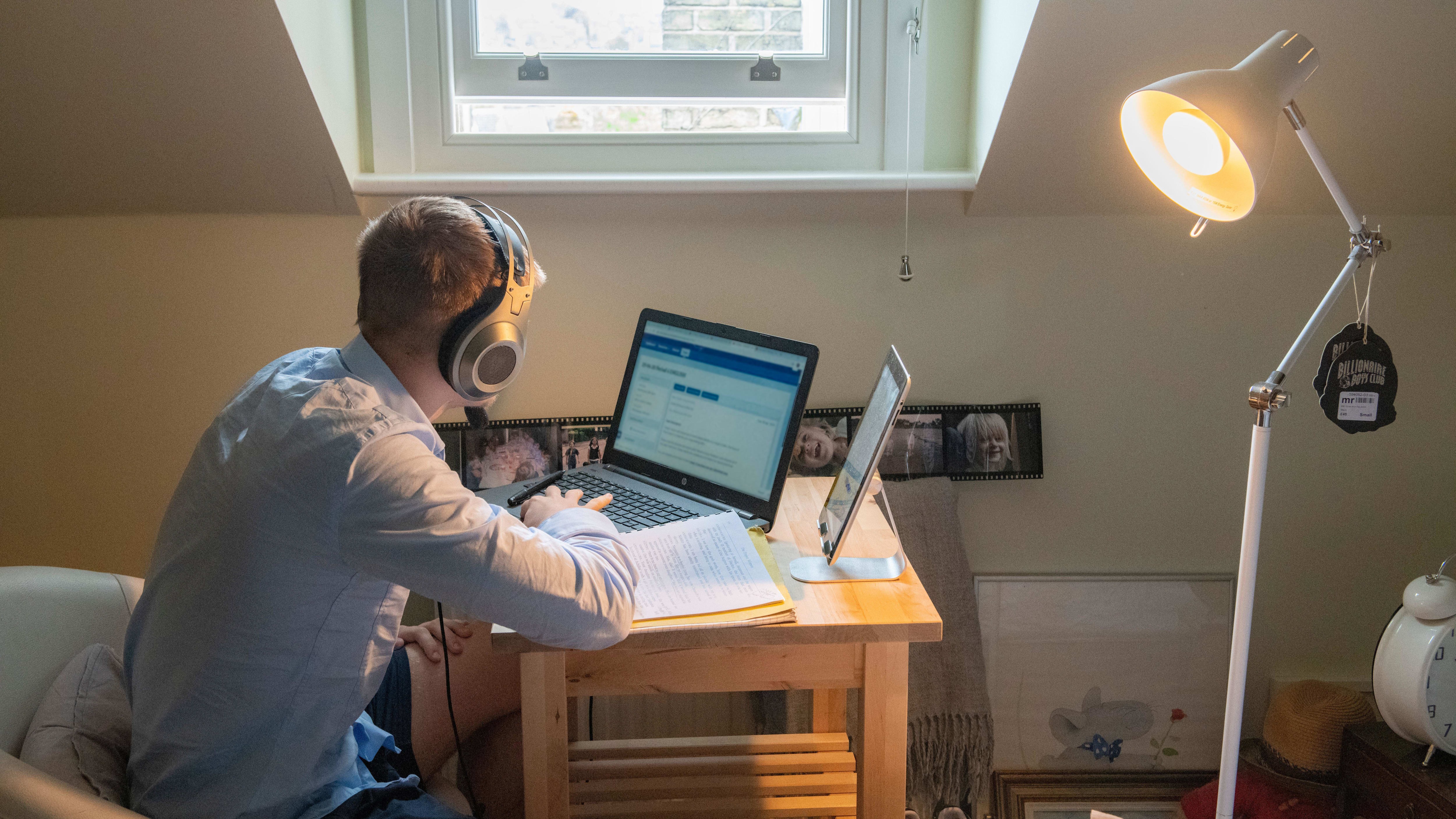
When Sam’s daughter enrolled at an online school in April 2023, it initially proved to be a lifeline. Since the pandemic, the young teen had struggled to attend her mainstream school owing to extreme anxiety and other mental health conditions. Logging on at home allowed her to learn in a less triggering environment.
The 13-year-old, who is autistic, had an educational, health and care plan with the local council, which would fund her £12,600-a-year placement at Cambridge Home School Online (CHS). Sam shared with the online provider the document that specified her daughter “hates to be seen on camera while learning”, and said she was assured this request could be accommodated.
But less than a term later, Sam was told her daughter could not continue at CHS because the school had a “camera-on” requirement. Sam later looked at the company’s special educational needs policy and noticed that parts of it appeared to be lifted from other schools’ websites.
One sentence stated erroneously that the online education group was maintained by Derby city council. The FT found another reference to the school’s “governors”, despite the private company not having any.
“It’s a joke, an absolute joke,” said Sam, who asked to be referred to by her first name only to protect her daughter’s identity. “They don’t have a clue what they’re doing.” The disruption was a “huge setback” for her daughter’s mental and physical health, she said.

CHS declined to comment on individual cases but said students were expected to have cameras on so teachers could “support learning, monitor wellbeing and fulfil their safeguarding responsibilities”.
They said the policies were “historic” documents that “do not represent Cambridge Home School Online’s current operational policies or procedures”. The documents were removed from the website after the FT contacted CHS.
Sam’s daughter is one of a growing number of children in the UK whose education has shifted online, where an expanding marketplace of private, often unaccredited, providers is being funded by local authorities to teach children whose needs are not being met in mainstream schools.
While some parents the FT spoke to said virtual schools had been “life-changing”, experts said the lack of regulation raises concerns about oversight in a sector serving some of the UK’s most vulnerable children.
Although the overall number of children in online education remains relatively low, growth has been rapid. Council spending on online schools in England increased 19-fold between 2018-19 and 2024-25, according to FT analysis of data covering the 60 councils with comparable figures.

The data, obtained through Freedom of Information requests, revealed at least 3,397 students were taught through online schools in 2024-25. Only 69 of 151 eligible councils provided figures on pupil numbers, meaning the true figure is likely to be significantly higher.
The government recommends councils only commission providers accredited by Ofsted, the regulator, but there is no statutory requirement and many online schools — including CHS — are unaccredited.
“Because it’s exploded so fast as a practice, we’re a little bit on the back foot,” said Jo Hutchinson, director for special educational needs and disabilities (Send) and additional needs at the Education Policy Institute. “And because it’s not a legal requirement, that leaves open a really big loophole.”
Other experts and councils told the FT that the increased use of virtual schooling reflected existing challenges in the Send system, which has been brought to breaking point by spiralling debts, a shortage of special school placements and a rise in children with special educational needs, including what is known as “emotionally based school avoidance”.
“We knew all of those pressures existed and now we can see that this is one safety valve the system is using for those pressures,” said Hutchinson.

Some councils have utilised online schools far more than others. Norfolk county council accounts for more than a quarter of the £16.9mn spent on online schools in 2024-25 across the 83 councils that provided data. Its online pupil numbers have jumped from 11 to 923 since 2018-19, driving a 76-fold increase in the cost to £4.6mn.
Mary Bousted, former general secretary of the National Education Union, said the data raised questions about the inclusivity of mainstream education in the area. “Is it that the children have rejected the system or has the system rejected them?” she said.
Thirty councils told the FT they do not use online schools. Five of the 43 that provided pupil data for 2018-19 and 2024-25 have seen numbers decline over this period. The CHS said that less than 2 per cent of its students were funded by local authorities.
Norfolk said the local authority was investing in specialist and alternative provision as well as support for mainstream schools to reduce reliance on virtual schooling. “While online learning can be the right approach for some children and young people, we want the vast majority to be educated in mainstream settings,” they said.
They added that the council “applies robust commissioning and quality assurance processes aligned with the Department for Education’s voluntary national standards” to online providers and that the provision is often short term or part of a wider package including face-to-face support.
Since the government launched the voluntary Ofsted scheme in 2023, 16 online schools have been accredited. However, the scheme is only open to those that provide a full curriculum or represent a child’s main source of education, leaving many part-time providers unable to qualify.
Unaccredited providers are subject to checks by the local authority, but experts said many councils are too under-resourced to do proper due diligence.
“How do we know their safeguarding is good enough? How do we know they are being run by suitable people with the right qualifications and right motivations?” Hutchinson said. “In some cases [the local authority] is fully on top of it and in some cases they’re not.”
The Department of Education intends to review the accreditation scheme this year.
Ian Hopkinson, who has a child at Minerva Virtual Academy, an accredited provider, said their positive experience had led him to join Voice for Learners, a group advocating for the government to make access to accredited online schools easier.
“It’s been a complete life-changer for us,” added Hopkinson, who said he pays about £10,000 a year for Minerva. Prices charged by some online schools can vary hugely depending on individuals’ specific needs.
Bousted and Hutchinson said the long-term goal should be to improve inclusivity in mainstream schools.
“Is the answer to have a significant rise in online provision or is the answer to get [young people] back to school? My answer will always be the second,” added Bousted.
“School has always provided not just an educational function but a very important social function. It’s a very important area where children learn to grow up and how to integrate into society.”